


Lighting Engineering Solutions for the Building & Construction sector
Great construction projects contribute to a country’s prestige and reputation. Some examples are the Eiffel Tower, Golden Gate Bridge, Empire State Building and so on. These are large vertical structures that present a danger to low-altitude air traffic and must therefore be properly marked.
Therefore, the lighting is of the utmost importance.
To ensure that aircrafts pass such structures (skyscrapers, telecommunications towers, bridges, industrial chimneys, construction cranes) in completely safety, obstruction lights must make these structures clearly visible.
«When clients bring us a challenge, our engineers design the best engineering solution and succeed in satisfying them as the result of a process that has been tried and tested with thousands of applications installed worldwide.»

Complete solutions
Our engineering solutions include designing the entire system and supplying obstruction lights, control boards, photoelectric switches, junction boxes and all the accessories.

Regulatory requirements
When designing our systems, we take the client’s needs into the utmost consideration, without ever losing sight of the specific regulatory requirements concerning obstruction lighting systems (e.g. ICAO or other national regulations).

The “right” solution
We do not just want to provide “a” run-of-the-mill regulation-compliant system; where possible, we prefer to design “the” right system. For eg. skyscrapers are beautiful and eye-catching buildings and one of our challenges also consists in minimizing the impact of obstruction lights to the aesthetics of the structure.
Extreme weather conditions
Our engineering solutions are designed and manufactured in order to be intended for use in extreme weather conditions. Our obstruction lighting systems work in freezing or sweltering temperatures in marine, desert and sandy environments.

Remote control and monitoring
It is essential to know the system’s status at all times, assess its efficiency and identify any anomalies. Our Telemetry Monitoring System enables the system’s status, faults, alarms and temperatures to be known in real time.

Reduced TCO cost
Efficient engineering involves reducing the TCO cost, not only as a result of designing resistant, reliable systems that require minimal interventions, but also through the development of innovative maintenance management features, such as our patented Retractable Maintenance System.
Regulations for obstruction lighting systems in the Building & Construction sector
There is no single regulation that defines the minimum mandatory requirements regarding the design and installation of obstruction lighting systems. The reference guidelines are the international ones developed by the ICAO; however, some countries have opted to draw up their own domestic regulation (the most important of which is the one developed by the FAA for the USA). The applicable regulations therefore depend on where the structures will be installed: skyscrapers, telecommunications towers, industrial chimneys, cranes, etc.
«We help our clients develop their applications all over the world, by supporting them with our expertise. During our 30+ years in business, we have designed systems for all types of regulations, such as those of the ICAO, FAA, ENAC and CAA.»
 |
ICAO (International Civil Aviation Organization, a specialized agency of the United Nations) |
 |
FAA (Federal Aviation Administration, an agency of the United States Department of Transportation) |
 |
CAA (Civial Aviation Authority, the UK’s specialist aviation regulator) |
 |
ENAC (Italian Civil Aviation Authority) |
Obstruction lighting system configurations for high-rise structures
Annex 14, Volume I (Aerodrome Design and Operations) of the “Convention on International Civil Aviation”, drawn up by the ICAO (International Civil Aviation Organisation), contains the rules that define “what” and “how” to provide markings in order to ensure the safety and regularity of air navigation.
The structures to be marked are defined as “aircraft obstacles” and are usually large vertical constructions, such as tall buildings, industrial chimneys, water towers, cooling tower, construction cranes, etc.
Visual marking consists of aircraft warning paint and/or obstruction lights. There is no single layout: the number and type of lights to use is variable and depends on the type of structure, the context in which it is installed and the client’s objectives.
«It is the designer’s responsibility to analyse the project specifications and find the best solution in terms of functionality, cost and regulatory compliance.»
Fundamental rules:
- Structures with a height of 45 m or less must be marked during the night with LIOL-B lights (Low Intensity Obstruction Lights, Type-B) installed at the top.
- The number of lighting levels depends on the height of the structure (H > 45 m).
- The arrangement of the lights (and the quantity) on each level, depends on the shape of the structure and must be such as to allow lights to be seen from every angle in azimuth.
- If the structures to be marked are very big or numerous (e.g. groups of buildings), the final objective of the marking system is to convey the overall outline.
Tall buildings, apartment buildings and skyscrapers are structures that easily exceed 45 metres in height and can therefore pose a risk for air traffic: these structures must be made clearly visible.
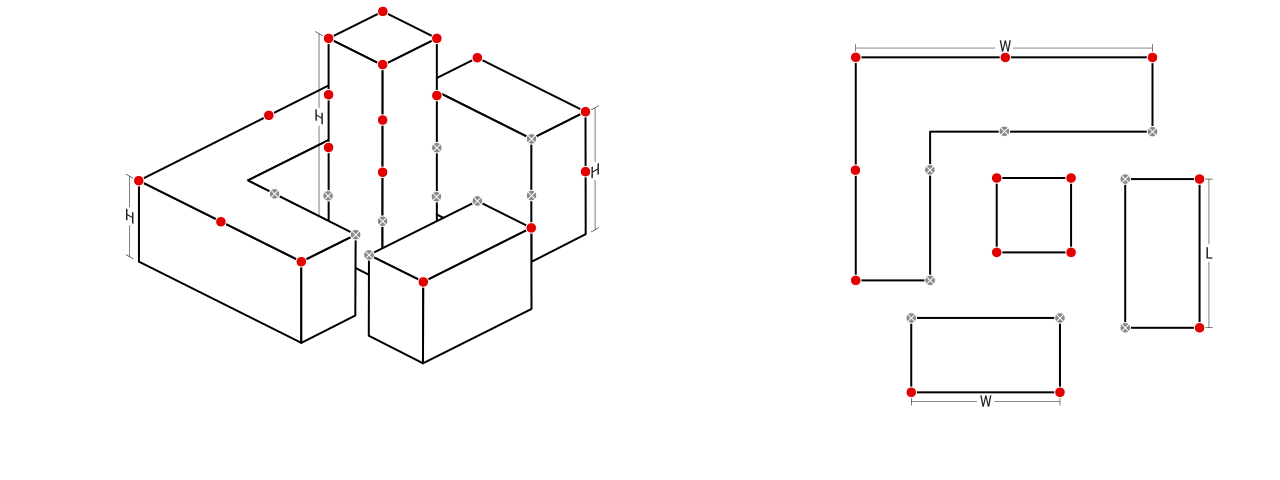
How many lights per level?
| L and W < 45m | 4 lights must be used (one in each angle) |
| 45m < W < 90m | 1 additional light must be positioned at the half-way point of the W |
| L and W > 90m | The lights must be spaced at intervals not exceeding 45 m |
Chimneys extract flue gas and industrial fumes. They are very large vertical structures – most are taller than 200 metres, such as coal-fired thermal power stations – and for this reason, they must be properly marked so that they are clearly visible, both day and night.
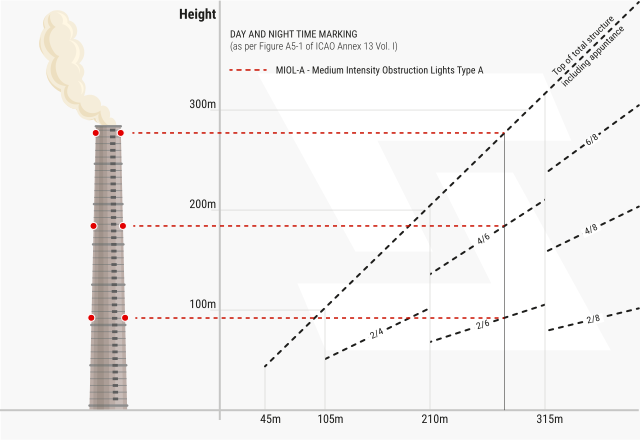
How many lights per level?
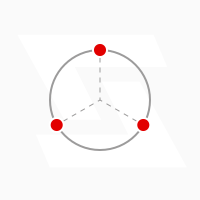 |
Diameter < 6m3 warning lights must be used (120°) for chimneys with a circular base of less than 6 metres. |
 |
Diameter > 6m4 warning lights must be used (90°) for chimneys with a circular base of more than 6 metres. |
Since there are so many different types of cranes, each layout should be analysed on a case by case basis: floating cranes, mobile cranes, construction cranes, telescopic cranes, self-erecting cranes, overhead cranes, etc. All of these structures can exceed 45 metres and therefore, must clearly be visible both day and night.
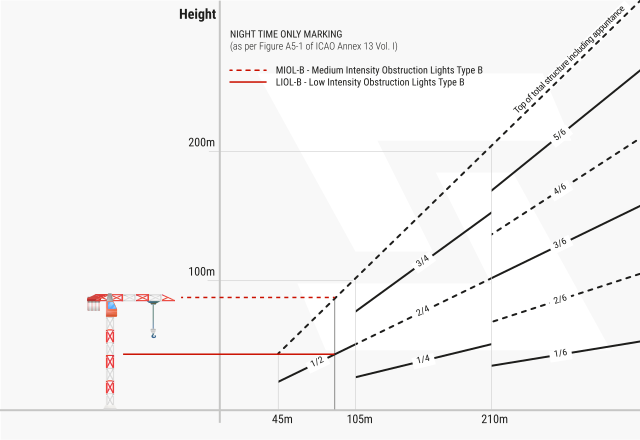
How many lights per level?
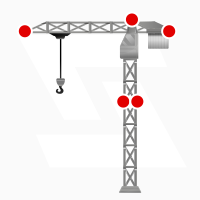 |
Top levelFrom 1 to 3 obstruction lights: at the top and, if necessary, at jib and counter-jib. |
 |
Other levels1 or 2 lights must be used on the other levels to mark the structure from every angle. |
Water towers are vertical structures that are designed to support a water tank; the tank is positioned at a height sufficient to pressurise the system in order to distribute drinking water. Water towers and water tanks pose risks to aviation safety and therefore, their position must be properly marked.
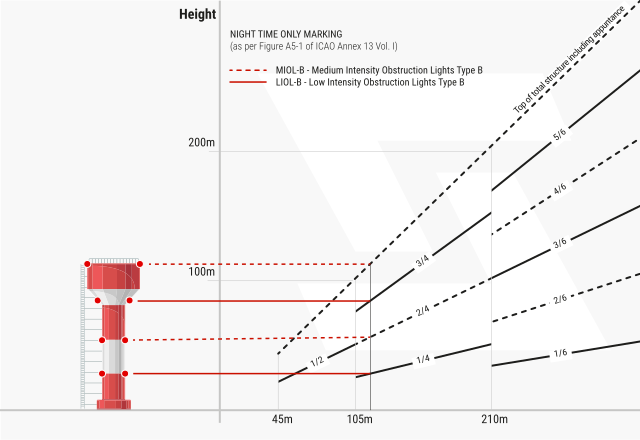
How many lights per level?
|
Diameter < 6m3 lights must be used (120°) for water tower with a circular base of less than 6 metres. |
|
6m < Diameter < 31m4 lights must be used (90°) for water tower with a circular base between 6 and 31 metres. |
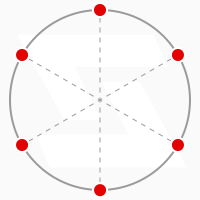 |
Diameter > 31m6 lights must be used (60°) for water towers with a circular base of more than 31 metres. |
Cooling towers are vertical structures that extract waste heat by cooling the water stream to a lower temperature by bringing air and water into direct contact with one another. There are several different types of cooling towers, ranging from the small rooftop units to the large hyperboloid structures that can reach 200 metres in height and 100 metres in diameter.
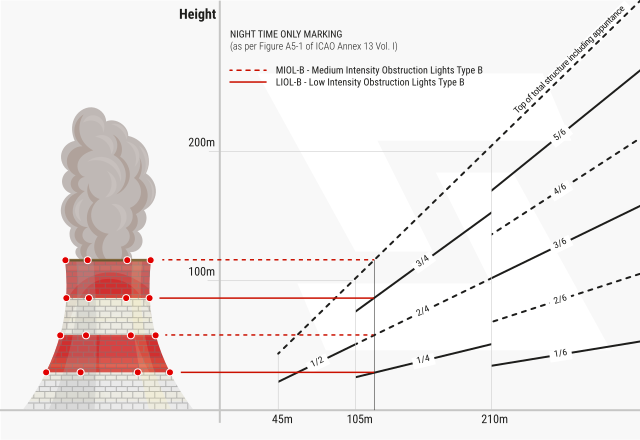
How many lights per level?
|
Diameter < 31m4 lights must be used (90°) for water tower with a circular base between 6 and 31 metres. |
|
Diameter > 31m6 lights must be used (60°) for water towers with a circular base of more than 31 metres. |
Tall buildings, apartment buildings and skyscrapers are structures that easily exceed 45 metres in height and can therefore pose a risk for air traffic: these structures must be made clearly visible.
How many lights per level?
| L and W < 45m | 4 lights must be used (one in each angle) |
| 45m < W < 90m | 1 additional light must be positioned at the half-way point of the W |
| L and W > 90m | The lights must be spaced at intervals not exceeding 45 m |
Chimneys extract flue gas and industrial fumes. They are very large vertical structures – most are taller than 200 metres, such as coal-fired thermal power stations – and for this reason, they must be properly marked so that they are clearly visible, both day and night.
How many lights per level?
|
Diameter < 6m3 warning lights must be used (120°) for chimneys with a circular base of less than 6 metres. |
|
Diameter > 6m4 warning lights must be used (90°) for chimneys with a circular base of more than 6 metres. |
Since there are so many different types of cranes, each layout should be analysed on a case by case basis: floating cranes, mobile cranes, construction cranes, telescopic cranes, self-erecting cranes, overhead cranes, etc. All of these structures can exceed 45 metres and therefore, must clearly be visible both day and night.
How many lights per level?
|
Top levelFrom 1 to 3 obstruction lights: at the top and, if necessary, at jib and counter-jib. |
|
Other levels1 or 2 lights must be used on the other levels to mark the structure from every angle. |
Water towers are vertical structures that are designed to support a water tank; the tank is positioned at a height sufficient to pressurise the system in order to distribute drinking water. Water towers and water tanks pose risks to aviation safety and therefore, their position must be properly marked.
How many lights per level?
|
Diameter < 6m3 lights must be used (120°) for water tower with a circular base of less than 6 metres. |
|
6m < Diameter < 31m4 lights must be used (90°) for water tower with a circular base between 6 and 31 metres. |
|
Diameter > 31m6 lights must be used (60°) for water towers with a circular base of more than 31 metres. |
Cooling towers are vertical structures that extract waste heat by cooling the water stream to a lower temperature by bringing air and water into direct contact with one another. There are several different types of cooling towers, ranging from the small rooftop units to the large hyperboloid structures that can reach 200 metres in height and 100 metres in diameter.
How many lights per level?
|
Diameter < 31m4 lights must be used (90°) for water tower with a circular base between 6 and 31 metres. |
|
Diameter > 31m6 lights must be used (60°) for water towers with a circular base of more than 31 metres. |